Shortcuts to the project
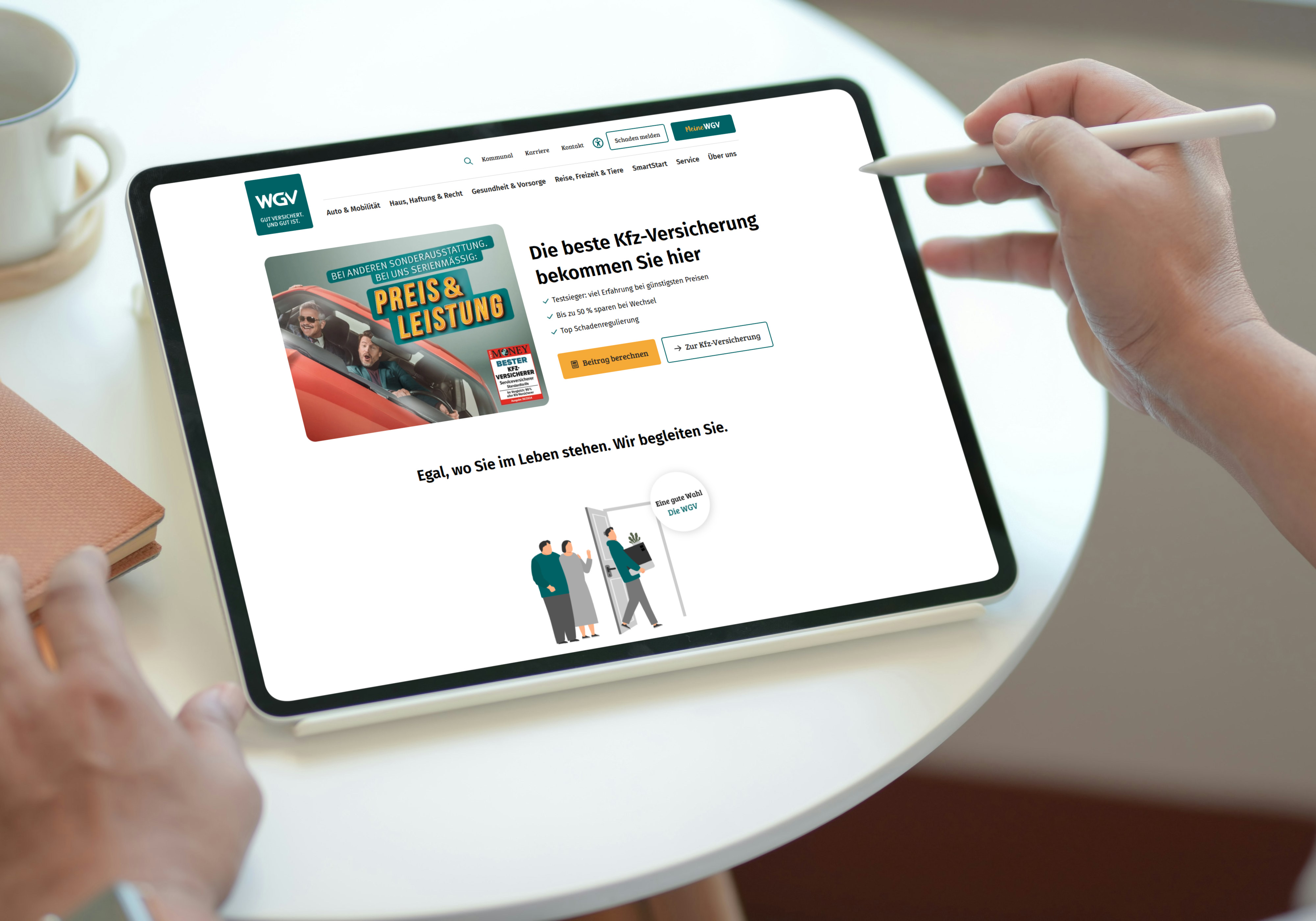
The goal of the project was to completely relaunch the wgv.de website in order to strengthen WGV's digital presence and offer customers an improved online experience. In addition to a modern and accessible design, the focus was on an intuitive user experience that promotes both user-friendliness and customer loyalty. For the conception and design, we conducted two requirements workshops and further developed the existing modules based on the requirements. For the technical implementation of the project, we used the latest version of First Spirit and migrated it to the cloud. This ensures a powerful and secure basis for the operation of the website. In addition, our front-end development framework Frontwerk was used.
Advantages of Frontwerk
Visualization before completion: The design can be presented during the development phase to facilitate the approval process.
Testing options: Various use cases and design variations can be tested and optimized.
Documentation and style guide: Frontwerk provides comprehensive project documentation, including a component catalog and style guide.
Phase 1: Concept and design process
- 1
Requirements workshops
At the start of the project, we conducted two detailed workshops with WGV. The aim was to comprehensively identify the customer's requirements and develop a shared vision for the project. In doing so, we worked out specific needs and expectations for the website.
- 2
Target group definition
We then defined the relevant target groups. This analysis served as the basis for creating a user experience tailored to the needs and expectations of WGV customers.
- 3
Analysis of components and definition of page templates
In the third step, we analyzed the existing website components and used this information to develop a structure for the new page templates. We designed these to be flexible, expandable, and easy to maintain.
- 4
Inventory and further development
We systematically reviewed the existing modules of the previous website. Based on the new requirements, we further developed these to meet the new standards and the desired user experience.
- 5
UX/UI: Systematic structure
For the user experience (UX) and user interface (UI), we opted for a systemic structure. We developed a coherent design system that combines modern aesthetics with functional requirements. The focus was on intuitive and consistent user guidance.
- 6
Prototype development
To ensure transparent and efficient coordination, we developed interactive prototypes. These were used to present and approve the design before development began. This allowed everyone involved to get a feel for the final website at an early stage and incorporate any changes.
Phase 2: Technical requirements assessment
- 1
Backlog Refinement
Creation of user stories and technical acceptance criteria: Our goal was to create clearly formulated user stories that facilitate development work, improve quality assurance, and enable transparent acceptance by the customer.
- 2
Presentation to the entire development team
Knowledge transfer: We presented the requirements to the entire team in order to reduce changeover times in the event of failures and to ensure knowledge transfer. Quality assurance: By identifying potential side effects and avoiding duplication of work, we were able to increase efficiency within the team. Joint estimation: The team estimated the user stories together, which enabled realistic time and resource planning.
Phase 3: Agile development and iterative delivery
- 1
Milestone planning and forecasting
Based on the backlog, we defined clear development goals for each milestone to ensure structured and transparent implementation.
- 2
Agile, iterative development
Development took place in two-week sprints, which enabled continuous delivery and regular feedback.
- 3
Validation of team velocity
After each sprint ended, we reviewed the team's velocity in order to continuously optimize planning and the development process.
- 4
Forecast based on backlog and velocity
Regular updates to the forecast ensured transparency regarding delivery capabilities and enabled efficient adjustments to planning.
- 5
Sprint and status reports to the customer
To ensure close coordination, we prepared detailed reports that informed the customer about progress and the current project status.
Added value through the relaunch
Design and user experience
The new website has a contemporary, user-centered layout. The aim was to offer customers a first-class user experience. We created a modern and visually appealing design, while optimizing navigation to enable faster access to information. The new website meets the requirements of conformance level AA according to the Web Content Accessibility Guidelines (WCAG).
Performance and security
First Spirit's cloud migration enabled us to create a modern infrastructure that has significantly improved the performance and security of the website.
Documentation and transparency
The comprehensive project documentation in Frontwerk enables transparent tracking of progress and ensures that all project participants are kept informed of the current status at all times.
Interested in digital transformation? Contact us now and start your individual project!