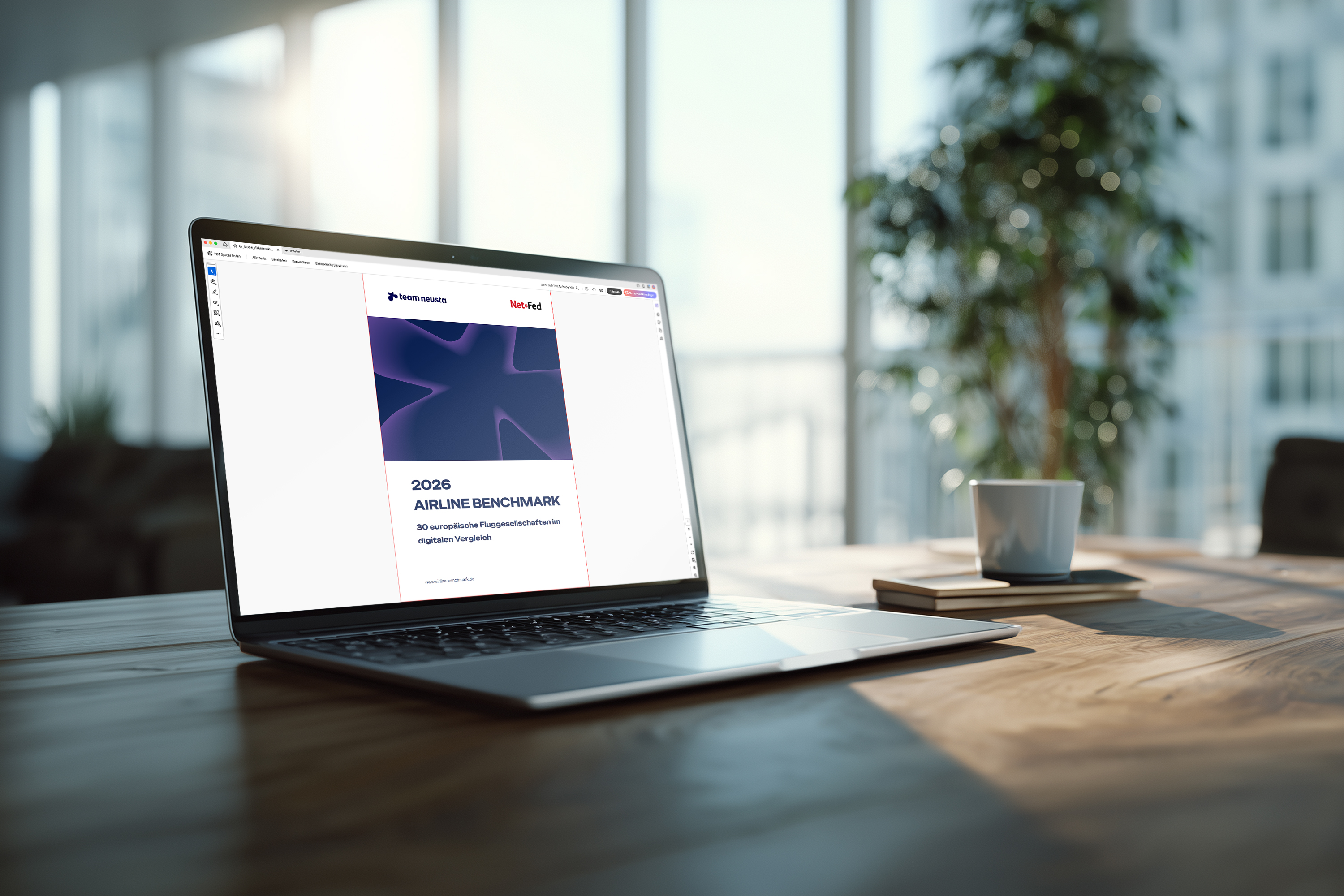
Bremen, June 8, 2026 – As of July 1, Lufthansa will discontinue its direct flight from Bremen to Frankfurt. For many travelers, this means transfers, longer journeys, and new decisions. And this raises a question that is long overdue: Which airline clearly shows me what my ticket really costs, what connections are available, and the best way to get to the airport? A new study by team neusta and NetFederation provides systematic answers to these questions for the first time.
The Airline Benchmark 2026 examined 30 European airlines based on 126 criteria—not from the perspective of IT departments, but from that of people who simply want to book a good flight.
Hidden costs, missing trains, no price alerts
Anyone heading to the airport asks themselves: How do I get there? Is there a train-and-flight combo? What will it really cost me? The study shows: Not all airlines answer these simple questions satisfactorily.
Only 50% of airlines clearly disclose fuel surcharges; for the other half, you only find out the true price shortly before booking.
Only 60% of airlines offer Rail & Fly options: anyone who needs to fly from Bremen to other airports and wants to travel by train will find that nearly one in three airlines does not offer an integrated package.
Only 33% of airlines offer price alerts: those waiting for a cheap ticket have to check daily themselves with most airlines.
Lufthansa in the lead – Pegasus surprises
Lufthansa tops the overall ranking with 846 out of 1,000 points and particularly impresses with its booking experience: clear prices in the calendar, easy seat selection, seamless additional services. Close behind are TUI fly and Norwegian.
A real surprise: The Turkish low-cost airline Pegasus Airlines is the only airline in the benchmark already using AI-powered search and an intelligent chatbot. Anyone who types “I’m looking for a cheap flight next Friday” on pegasus.com immediately receives useful suggestions—a convenience that most European market leaders do not yet offer.
One in four airline apps falls short
For most travelers, the app is the most important digital touchpoint for checking in, retrieving boarding passes, and tracking flight changes. The study shows: There is significant room for improvement here. Only 73% of airline apps achieve an average rating of at least 4 stars in the App Store—the threshold at which users perceive an app as reliable. And not a single airline app reaches 5 stars.
This is particularly true when travelers need to rebook at short notice—for example, because a connecting flight is canceled and an alternative must be found quickly. Anyone who has ever stood at the gate with a crashing app or a boarding pass that won’t load knows why this matters.
Climate goals communicated, carbon footprint concealed
Nearly all airlines—around 90%—communicate specific climate goals. But a closer look reveals a striking gap: Only 37% of airlines transparently disclose their fleet’s actual carbon footprint. The intention is communicated, but the results are rarely shared.
The contradiction becomes even clearer when looking at their own digital infrastructure: 60% of airline servers do not run on green electricity. Any airline that wants to credibly champion sustainability should not only focus on its fleet but also on the ecological footprint of its own website.
Accessible on paper, not in practice
60% of the airline websites examined do not meet the technical standards for accessibility. While all airlines provide detailed information about accessible travel, their own websites are simply difficult for many people with disabilities to use. The Spanish airline Vueling has already been fined 90,000 euros for this. “If you want credibility, you must also act sustainably in the digital realm,” says Thorsten Greiten, Managing Director of NetFederation. “This is precisely one of the key takeaways from the benchmark: Digital quality does not arise in isolation from individual functions, but through the interplay of transparency, technical diligence, and strategic clarity.”
AI is searching—but hardly any airline is truly ready
When planning a trip, more and more people no longer turn to a search engine first, but to an AI assistant: “Find a cheap flight to Milan next weekend. ” The good news: 29 out of 30 airlines already allow AI systems access to their data. The bad news: Only 6 airlines actively use AI on their own websites. “Many airlines are opening their doors to AI crawlers—that’s the bare minimum. But the next step—actively using AI to enhance the customer experience—is something almost no one has mastered,” says Dirk Kabus, Managing Director at team neusta.
Pioneer Wizz Air goes even further: The Hungarian low-cost airline is the first European carrier to set up special interfaces for AI assistants. There, AI systems can retrieve flight data, prices, and availability in real time, not as annoying crawlers, but as a full-fledged sales channel.
A 300-point gap and how airlines are catching up
There is a gap of nearly 300 points between the top and bottom performers in the ranking. This is no coincidence, but rather a reflection of strategic priorities and strategic gaps. Yet the field is tighter than it appears at first glance: in the middle of the pack, only a few points separate 11th place from 25th. Those who take targeted action can quickly make up ground.
Many of the identified shortcomings do not require major technical projects. Disclosing fuel surcharges transparently, setting up a price alert, expanding airport information—these are measures that can be implemented in the short term and directly contribute to travelers’ trust. Other areas such as technical accessibility, AI-powered search, or consistent sustainability communication require more lead time, but in light of growing regulatory requirements, they are no longer optional—they are mandatory.
The benchmark provides the foundation for this: it reveals where an airline stands in a European comparison. Especially for airports like Bremen, whose passengers will increasingly rely on alternative connections and airlines in the future, the digital quality of providers is becoming a real competitive factor. Airlines that are aware of their specific shortcomings and want to know which measures have the greatest impact can request a customized assessment based on the study.
NetFederation supports airlines in systematically closing digital gaps: not as a checklist, but as a strategic assessment with actionable next steps. Further information: www.netfederation.de
The complete study with rankings, trends, and recommendations is available for free download: Simply enter your email address at www.airline-benchmark.de – direct access!
Your contact person