
AI Bricks Workshop: Become an AI Expert in One Day

From a process concept to a tangible prototype: Together, we identify a meaningful use case for AI, assess its technical feasibility, and develop an initial AI module on the very same day.
Don't Just Discuss AI—Put It to the Test
Many organizations know that AI opens up new possibilities. However, it often remains unclear where exactly it can be used effectively in their day-to-day work.
In the AI Bricks Workshop, we therefore examine a specific business process from two perspectives: business and technical. Together, we identify the greatest opportunity for optimization, develop a realistic AI concept, and build an initial prototype based on it.
This provides a solid basis for decision-making within a single day—without a lengthy conceptual phase and without noncommittal buzzword bingo.

The result: a concrete AI prototype
By the end of the workshop, you’ll walk away not just with an idea, but with your first functional AI module for a selected process within your organization.
A First AI Prototype
You’ll receive a production-ready prototype that demonstrates exactly how AI can support your selected processes—tangible, testable, and practical.
Clear Assessment of Feasibility
Together, we'll assess the technical requirements, the expected effort, and the added value the solution can bring to your organization.
Understanding the Appropriate Uses of AI
The workshop provides a shared understanding of where AI offers real benefits and where its use is less appropriate.
Transparency Regarding Technology and Data
You'll gain clarity on the necessary systems, data sources, and interfaces, as well as any potential technical or organizational challenges
Specific recommendations for the next steps
All results will be documented in a workshop report. In it, you will find the proposed solution, as well as recommendations for further developing the prototype and a potential rollout.
How the AI Bricks Workshop Works
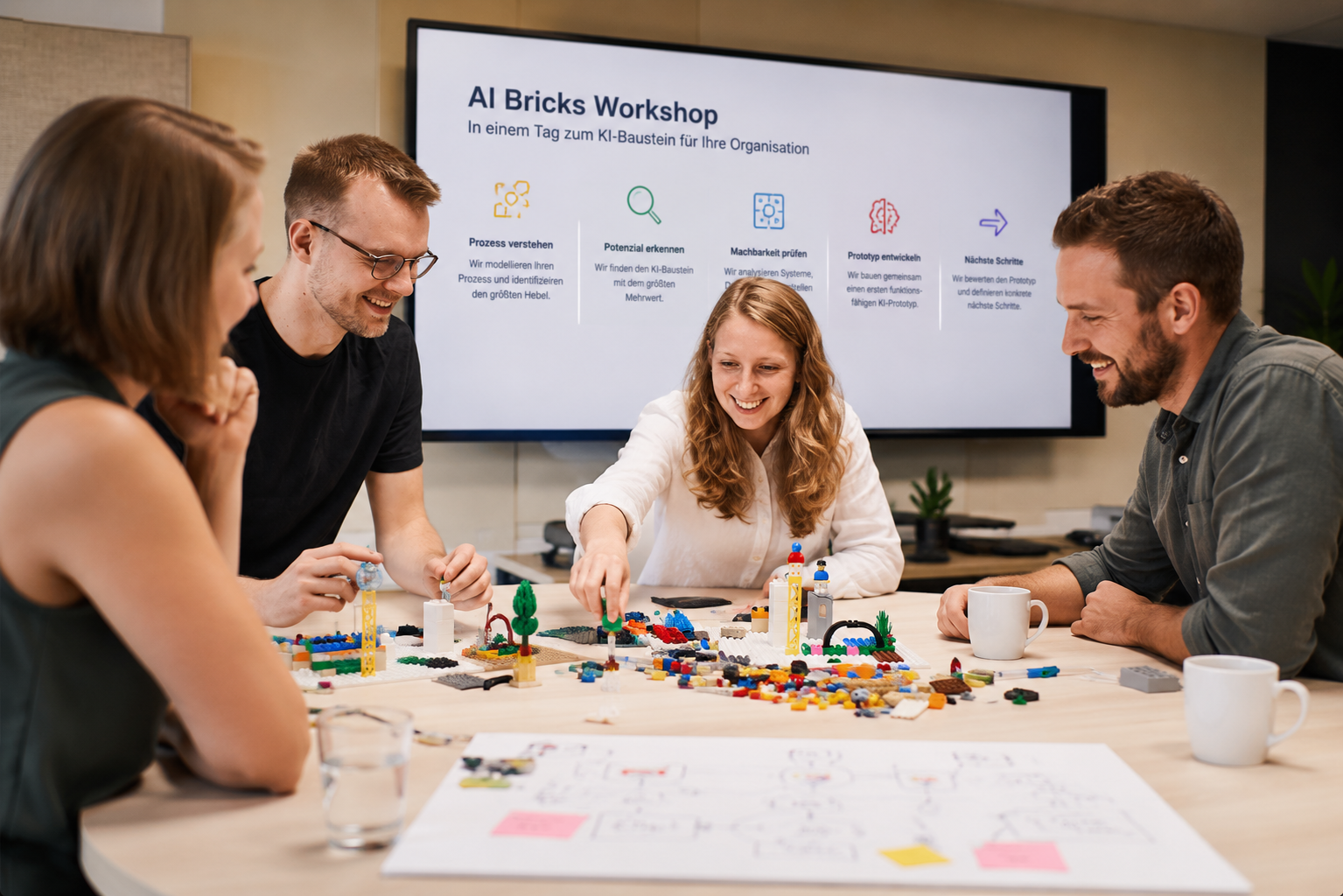
- 1Select and Understand the Process
The Technical Team uses LEGO® Serious Play® to model a selected business process. This process highlights workflows, dependencies, vulnerabilities, and potential single points of failure. The goal is not to discuss the process in abstract terms, but to make it tangible through collaborative work.
- 2Identify the greatest AI lever
Based on the process model, we assess where AI can create real added value. Our focus includes, for example: manual and repetitive tasks, media breaks and unnecessary handoffs, time-consuming research and reviews, missing or hard-to-access knowledge, sources of error, and critical dependencies. Together, we prioritize the use case with the greatest realistic impact.
- 3Assess Technical Feasibility
At the same time, the Technical Team analyzes the relevant systems, data sources, databases, and interfaces. In doing so, we determine, among other things: What data is available and accessible? Which systems need to be integrated? What security and data protection requirements exist? What technical architecture is appropriate? What prerequisites might still be missing?
- 4Develop an AI Prototype
Based on the conceptual idea and technical analysis, we work together to develop an initial prototype. Depending on the use case, this prototype can, for example, research information, provide knowledge, structure content, automate processes, or assist employees in making decisions.
- 5Evaluate the results and plan the next steps
To wrap up, we’ll review the prototype together and evaluate: expected benefits, technical feasibility, the effort required for further development, risks, and open questions, as well as possible next phases of development. This will provide you with a solid foundation for deciding whether and how the AI module should be further developed.
TWO TEAMS, ONE SHARED EXPERIENCE
To ensure that business requirements and technical capabilities align from the start, two customer teams work in parallel during the workshop.
Professional Expertise Team
The team brings process expertise, organizational experience, and decision-making authority to the table. It understands the workflows, challenges, and requirements of the selected use case.
Technical Team
The technical team is familiar with the systems, data, and interfaces involved. Ideally, it has the necessary access or admin privileges to be able to assess the technical situation directly.
Possible AI Components
The type of prototype produced depends on the selected process. Possible examples include:
Internal Knowledge Assistant
Makes corporate knowledge available at any time using natural language—regardless of individual experts or document repositories.
AI-powered research
Let information from internal and external sources be automatically researched, consolidated, and presented in an easy-to-understand format.
Automated Document Review
Checks, analyzes, and classifies documents such as contracts, invoices, or applications more quickly and with less manual effort.
Data Analysis Using Voice Commands
Ask questions about your company data in natural language and get easy-to-understand analyses without complex reports.
Smart Prequalification
Automatically evaluates and prioritizes inquiries, applications, or leads based on defined criteria.
Summary or Classification
Automatically summarizes emails, meeting minutes, or documents and assigns content to the appropriate categories.
AI-powered workflows
It automates recurring process steps and connects various systems to create end-to-end digital workflows.
Digital Assistance for Academic Departments
Supports employees in service, sales, administration, or other departments with intelligent AI assistants in their day-to-day work.
Technical Foundation for Rapid Prototyping
Depending on the use case, various technologies and models are available for implementation. These include, among others:
- various AI models, including locally hosted LLMs (Large Language Models)
- local AI models
- the neusta AI Suite
- Retrieval-Augmented Generation, or RAG for short
- n8n for workflow automation
- Rapid prototyping with Spec-Driven Development
- GDPR-compliant AI hosting in Germany
We determine which technical solution to use based on the specific process, the existing IT landscape, and the respective data protection and information security requirements.
Develop Securely and in Compliance with the GDPR
Security must be taken into account from the very beginning, especially when it comes to internal processes and sensitive company data.
For the prototype, therefore, options include hosting in Germany, local models, and architectures that prevent uncontrolled data leakage.
We consider data protection, access rights, system limitations, and potential risks not just after development, but right from the design phase of the AI module.
Who is this workshop intended for?
The AI Bricks Workshop is open to all industries and is aimed at organizations of all sizes that want to test AI using a specific business process.
This format is particularly well-suited if you:
- want to improve a clearly defined process
- haven’t yet identified a suitable AI use case
- want to test an idea before making a major investment
- want to bring business and IT together early on
- are looking for a realistic assessment rather than a purely strategic discussion
- want to achieve a visible result within a short period of time
Prerequisites include a business team with process knowledge and decision-making authority, as well as, if possible, a technical team with knowledge of the systems involved.
Here's what our customer says
Your Benefits at a Glance
Getting from the problem to the solution faster
Within a single day, a specific process is transformed into a tangible AI approach.
Evaluate Investments Thoroughly
You'll receive a realistic assessment of the effort involved, the impact, and technical feasibility.
Bringing Business Units and IT Together
Both perspectives are incorporated into the solution from the very beginning.
Identifying Risks Early
Technical, organizational, and data protection issues are addressed directly.
Receive a prototype instead of a presentation
The result isn't just a loose collection of ideas, but an initial AI building block that you can test and evaluate together.
From One Day to the Next Step in Development
After the workshop, the prototype can serve as a foundation for further steps. Depending on the results, we can assist you with, for example:
- Validation with real users
- Technical development
- Integration of additional systems
- Building a production-ready architecture
- Data protection and security concepts
- Scaling to additional processes
- Implementation and change management
The workshop does not obligate you to proceed with implementation afterward. You’ll receive an independent basis for decision-making and can then make an informed decision about how to proceed.
FREQUENTLY ASKED QUESTIONS ABOUT AI BRICKS
How long does the AI Bricks workshop last?
The workshop is designed as a one-day event. The selection of the process and the organizational preparations are made in advance during a brief coordination meeting.
Can a prototype really be ready in just one day?
The goal of the workshop is to produce an initial, functional prototype. Its scope depends on the use case, the available data, and the available interfaces. During the preliminary discussion, we will determine which process is best suited for the format.
Do we need to have a specific AI idea already?
No. To start with, all you need is a suitable business process or a specific challenge. We’ll work together in the workshop to develop and prioritize the most effective AI approach.
Which employees should participate?
We need participants from the department with detailed process knowledge and, if possible, colleagues from IT or development who are familiar with the systems, data, and interfaces involved.
Do we need technical approaches?
To create a prototype that is as realistic as possible, access to the relevant systems or test environments is helpful. We will determine in advance which permissions are required.
What happens to our data?
The technical implementation will be tailored to your data protection and security requirements. Depending on the use case, local models and GDPR-compliant hosting in Germany may be used.
SCHEDULE YOUR NO-OBLIGATION INITIAL CONSULTATION NOW.